West Side native challenges political establishment in Illinois 7th District, refusing corporate money while fighting for healthcare equity and economic justice
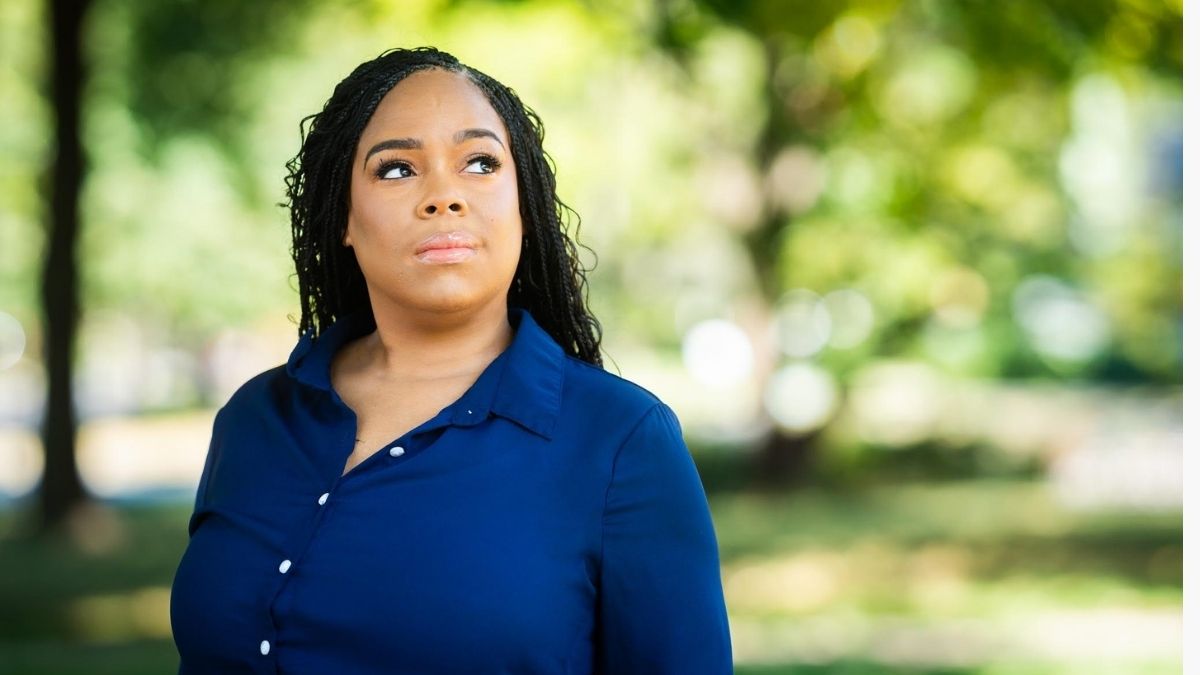
Kina Collins didn’t wait for it to be popular or safe to challenge the political establishment. Six years ago, when she first ran against longtime Congressman Danny Davis, she called for the abolition of ICE and refused corporate money—positions that seemed radical at the time but have since become mainstream progressive talking points.

Now, as a candidate for U.S. Congress in Illinois’ 7th Congressional District, Collins is making the case that her years of bold, consistent advocacy—even when it wasn’t the “cool thing to do”—make her the candidate who will actually fight for the working-class communities of Chicago’s West Side.
“We’ve been talking about this for the last six years,” Collins states. “We’ve been ringing the alarm about what has been happening with the deterioration of our democracy, that billionaires are literally running our government, and that working-class people are being suppressed in this moment and not being represented enough.”
Daughter of the District
Collins is a daughter of the 7th District, born and raised on the West Side of Chicago. Her background is in organizing around gun violence prevention and criminal justice reform work—issues that have defined West Side communities for decades and require representatives who understand them intimately, not academically.
“Our campaign is focused very simply on centering working class voices, bringing equitable healthcare to the Illinois 7th Congressional District, fighting for a future free of gun violence here in Illinois 7, and increasingly, fighting for our democracy that is extremely fragile right now,” Collins explains.
She believes the next generation of West Siders can take the district to the next level—but only with leadership willing to challenge both the GOP and Democratic establishment when necessary.

A District of Extremes
The 7th Congressional District embodies America’s economic inequality in a microcosm. “We have the wealthiest communities that exist in America and some of the most working poor communities that exist across the country, and they’re all living within the boundaries of this district,” Collins notes.
The district is one of the most diverse in the United States, but also one of the most unequal. This economic disparity has led to declining quality of life and extraordinary inequality—inequality that manifests in ways both obvious and hidden.
The Death Gap Crisis
Perhaps the most shocking disparity Collins highlights is what she calls the “death gap”—the difference in life expectancy based solely on geography within the district.
“Illinois actually has the largest death gap in America between downtown Streeterville and West Englewood: a 30-year life gap based on a 30-minute car ride,” Collins reveals. “From downtown to the West Side in Garfield Park, it’s about a 20 to 24-year life gap based on a 20-minute car ride.”
The reasons are systemic: communities like Englewood and Garfield Park exist in what Collins calls “medical apartheid.” They’re food deserts without proper primary care. Residents face poor air quality and lead in their water pipes at levels higher than Flint, Michigan.
“We’re not making enough of a fuss about this,” she states bluntly. “We’re not calling people out enough. This is a crisis.”

Collins doesn’t sugarcoat the reality of infrastructure in parts of the 7th District. “There are communities that look like a bomb exploded,” she acknowledges.
Her infrastructure priorities start with necessities: clean water. The lead pipe servicing crisis must be addressed immediately, and she’s committed to holding the city, county, and state accountable for removing lead piping that’s poisoning a generation of children.
Supporting Small Businesses
Collins proposes creating a small business advisory council in the congressional office to directly engage the diverse business communities across the district—from Chinatown to Greektown to North Lawndale.
“I do think that there’s been a disconnect between our congressional office and working with some of these small business owners,” she observes.
She emphasizes that the district is a super-majority minority district: 51% identify as women, over 40% are African American, 20% are Latino, with a robust immigrant population. As DEI initiatives are being gutted, working with banks, financial institutions, and securing federal grants for these communities becomes even more critical.
Medicare for All and Healthcare Justice
Collins’s healthcare advocacy comes from direct organizing experience. Before running for Congress, she worked as a national organizer with Physicians for a National Health Program, training 20,000 doctors and medical students across the country to fight for a single-payer, universal healthcare system.
“I support Medicare for All and fighting for a universal healthcare system here in the United States as a whole, but especially for our residents here in Illinois 7,” Collins states. She’s calling for declaring a healthcare emergency in Illinois 7 based on the death gap.

The Right to Return
On the contentious issue of Cabrini-Green and displacement, Collins has a clear position: the right to return for families who were pushed out without a plan.
“There was no plan, and there were not enough jobs paying livable wages for these families to keep up with the cost of living here in the city of Chicago, and in that way they were forced and displaced out of their home—the only home that they knew,” Collins explains.
She has a strong stance on legally fighting for their right to return to those communities and that housing.

What Makes Collins Different
Her campaign decided from the beginning not to accept any corporate money or big spending—staying beholden only to district residents, constituents, and voters.
She argues that Trump is the symptom of a larger problem, noting that “some of the most heinous policies were paid for and put forth with Democrats in positions of power. We know that better than anybody in Chicago.”
She points out that in 2024, her campaign was the only one in the entire state of Illinois against which AIPAC spent money, trying to keep her out of the seat.
“If the people who are in opposition to the candidate that you’re supporting are big pharmaceutical companies, crypto bros, AIPAC, millionaires, and billionaires who are devoted to keeping you out of the seat, then you are the movement candidate,” Collins argues.
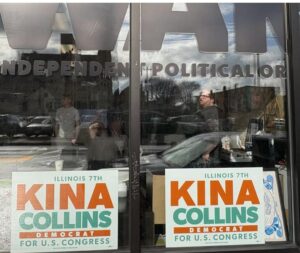
The 7th District deserves representation that reflects its diversity, understands its struggles, and fights for its future without fear or compromise. Kina Collins is betting that voters are ready for exactly that kind of leadership.