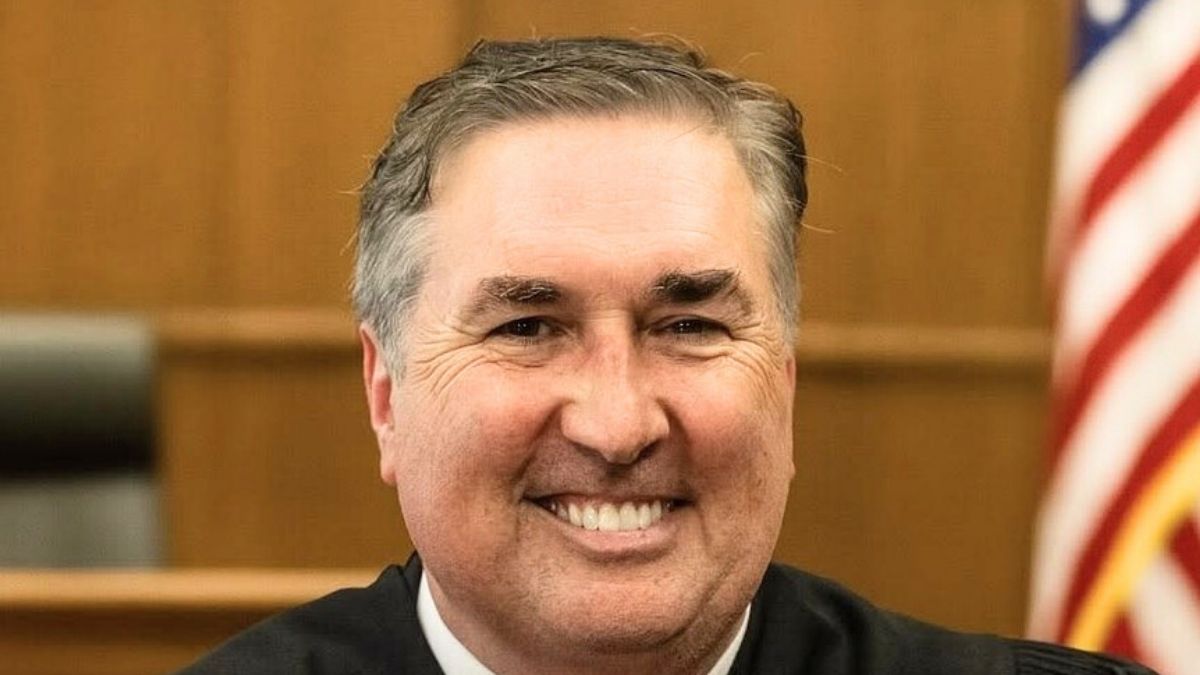
A Circuit Court judge brings three decades of public service to the Cook County bench, advocating for empathy and systemic reform.
When a woman appeared in Judge Michael Cabonargi’s traffic court with a six-year-old stop sign ticket, she wasn’t looking for sympathy—she just needed her driver’s license back so she could support her family. The city wanted $354.50 to dismiss the case, contingent on producing the officer who wrote the ticket six years earlier to testify that he remembered her running that stop sign.
Judge Cabonargi’s response captured his judicial philosophy in action: “If you can bring in the officer who wrote this ticket six years ago, swear him or her in, and they’ll testify they remember her blowing that stop sign six years ago, then you get $354 and 50 cents,” he told the city attorney. When they couldn’t, he dismissed the ticket.
“You have to show grace, dignity, and be an active listener and hear people,” Cabonargi explains.
A Foundation in Public Service
Judge Cabonargi describes himself as a first-generation American with over 30 years of experience in public service—and the first in his family to attend law school. His journey to the bench winds through some of the most respected institutions in American government.
Early in his career, he worked as an assistant to Senator Paul Simon, then clerked for a federal judge—experiences that gave him insight into both the legislative and judicial branches. He went on to serve as a federal prosecutor with the Securities and Exchange Commission (SEC), where he prosecuted complex financial crimes that required both legal expertise and the ability to explain complicated schemes to juries.
His public service expanded beyond the courtroom when he was appointed chair of the Cook County Board of Review, where he worked to ensure fair property taxes—a role that put him at the intersection of government finance, homeowner advocacy, and systemic equity issues.
Most recently, he served as a presidential appointee under President Biden as a regional director for the U.S. Department of Health and Human Services, overseeing federal health programs during the challenging years of the pandemic and its aftermath.
The Illinois Supreme Court unanimously appointed him as a judge, and he currently serves in the Circuit Court of Cook County’s traffic division—an assignment some might view as unglamorous, but one Cabonargi sees as an opportunity to impact lives and build public trust in the justice system.

When asked about the essential qualities for a judge, Cabonargi doesn’t begin with legal knowledge or judicial temperament—he starts with empathy, grace, and active listening.
“You have to meet people where they are as a judge, but you don’t leave them there,” he explains, describing an approach that acknowledges people’s circumstances while still holding them accountable and helping them move forward.
This philosophy comes from personal experience. “I’ve been blessed with grace, and I’ve known since I was a young man that the only thing I can do by myself is fail. Any success in my life is due to other people,” Cabonargi reflects.
Having received help and second chances throughout his own life, he understands that many people appearing in his courtroom aren’t criminals—they’re individuals facing challenges who made mistakes, often compounded by circumstances beyond their control.
Advocating for Systemic Change
While Cabonargi works to bring empathy and grace to individual cases, he’s also candid about systemic problems that can’t be solved by judicial compassion alone.
His most pointed criticism targets the funding of court operations. When someone gets a $100 ticket for running a stop sign, they don’t just pay $100—they pay $354.50, with $254.50 going to mandatory court costs.
“We fund the operations of the court on the backs of poor people,” Cabonargi states bluntly. “I think we need to look at how we fund our justice system and why are we funding it on the backs of people who can’t afford to pay a lot of times.”
This funding model creates perverse incentives: courts become dependent on revenue from fines and fees, disproportionately burdening low-income individuals who can least afford them.
“When people can’t pay, their licenses get suspended, making it harder to get to work, which makes it harder to earn money to pay the fines—a vicious cycle that punishes poverty.”
Cabonargi argues this system needs fundamental reform. “Courts should be funded through general revenue rather than relying on fees extracted from defendants, most of whom are low-income. Until that changes, judges can show individual grace, but the system itself remains inequitable.”
Community Connection
Beyond his courtroom responsibilities, Cabonargi emphasizes that judges have a leadership responsibility to remain engaged with the community that put them on the bench.
“Once you get on the bench, don’t forget, you’ve got to get back to the community that put you there,” he stresses.
From Traffic Court to Circuit Court
Judge Cabonargi is currently a candidate for Judge of the Circuit Court of Cook County, seeking to continue and expand the work he’s begun. While his current assignment is in traffic court, his background prosecuting financial crimes at the SEC and his experience across multiple areas of government have prepared him for the broader range of cases he would handle as a Circuit Court judge.

But perhaps more important than his impressive resume is his philosophy of meeting people where they are, showing grace when grace is warranted, and using the power of the bench to help people move forward rather than simply punishing their mistakes.
In many ways, traffic court is the face of the justice system for ordinary citizens. Most people will never appear in criminal court or civil court, but many will eventually find themselves in traffic court for a speeding ticket, an expired registration, or a stop sign violation.
How they’re treated in that courtroom—whether they’re shown respect or condescension, whether procedures are explained or assumed, whether their circumstances are considered or ignored—shapes their view of justice in America.